
Three techniques that look the same in a photo
Before comparing intarsia and jacquard it is worth separating them from the two things they are most often confused with. All four can produce a floral on a sweater; only two of them are knitted in.
| Technique | How the colour gets there | Tell on the surface | Tell on the reverse |
|---|---|---|---|
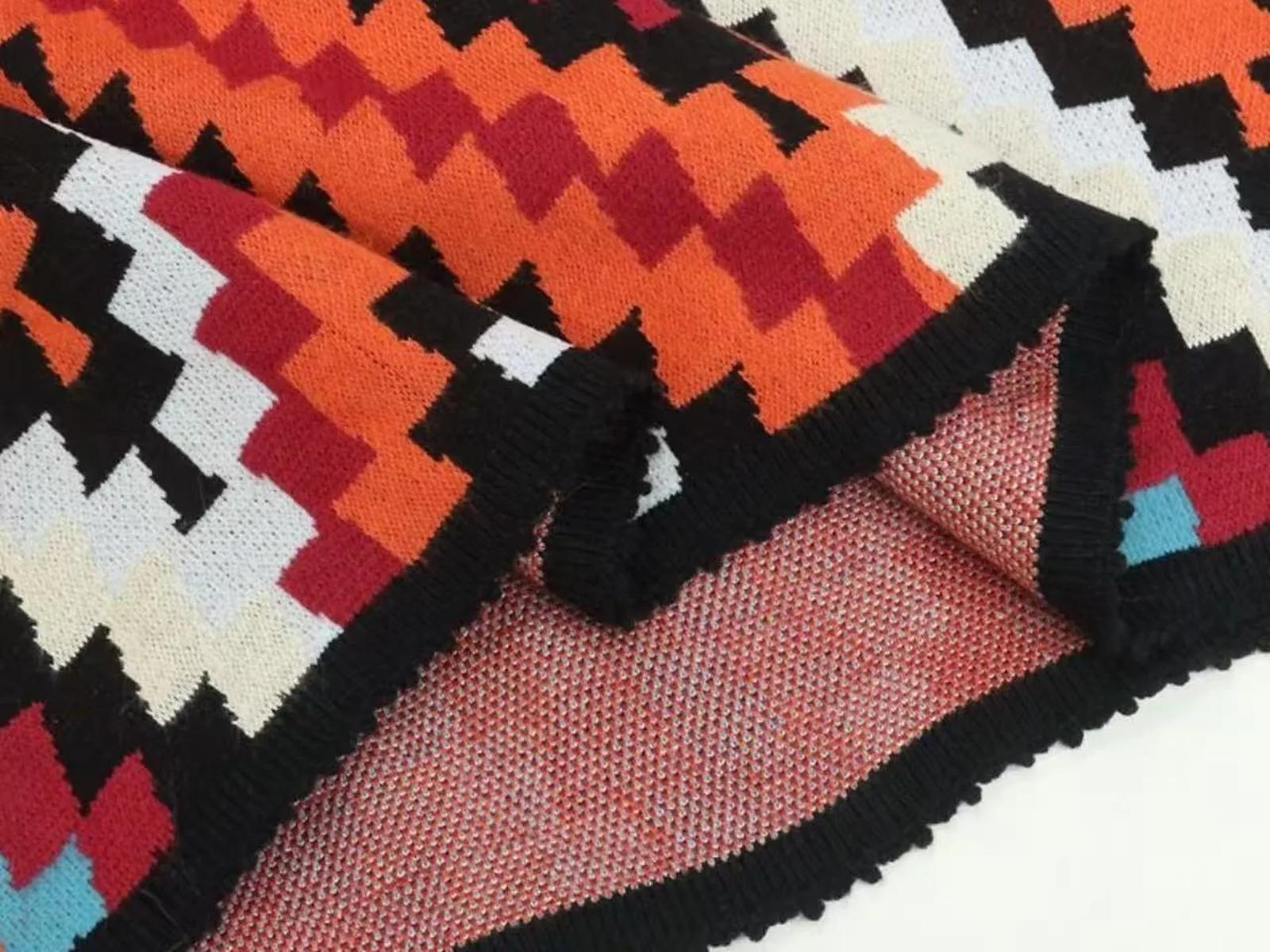
| Intarsia | Separate yarn per colour area, joined at the boundary | Stepped, interlocking edge; no surface thickness | Small yarn pockets at each junction, no floats across |
| Jacquard | Colours knitted in; unused yarns carried behind | Stepped edge, slight body and stiffness in dense areas | Horizontal floats across the back, longer with wider motifs |
| Applied onto a finished panel or piece | Sits on top; edge is smooth or halftone, never stepped | No structural difference; shows through on thin grounds | |
| Appliqué | Separate material stitched on | Visible thickness and a stitch or edge line | Stitch rows and backing |
A style in this category usually retails somewhere between USD 150 and 350, and the colour count is the single biggest lever on both cost and delivery.
Why the edge steps
A knitting machine builds a panel row by row from loops. When a colour changes mid-row, the new yarn has to be laid into the same loop structure as the old one, so the boundary can only move in whole stitches. That is what produces the staircase: each step is one needle. In a print, the same curve can be smooth, because a print has no loop structure to respect.
This is why artwork for knitted colour work has to be re-drawn on a stitch grid before it is quoted. A fine botanical outline that reads beautifully as a drawing can become a blunt, chunky shape at a coarse gauge, or require a much finer gauge - which changes the yarn, the weight and the price.
Which route fits which motif
| Motif type | Better route | Reason |
|---|---|---|
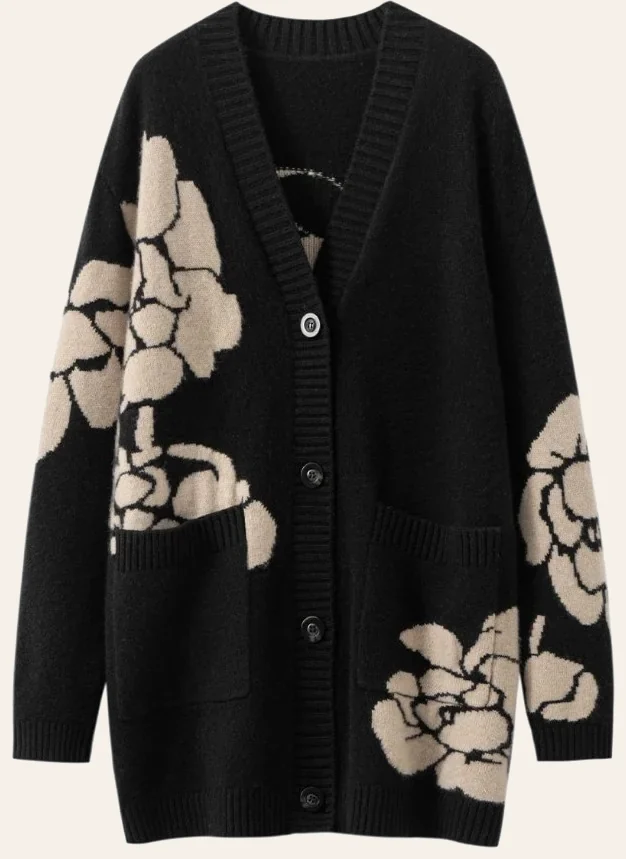
| Large floral with clean outlines | Intarsia | Each area has its own yarn, so the outline stays crisp and the back stays flat and light |
| All-over repeating pattern | Jacquard | Efficient across the full panel; the repeat is programmed once |
| Fine multi-colour artwork, 5+ colours | Jacquard, with a colour-count decision | Intarsia would need too many separate yarns and too much handling |
| Small chest motif on a plain body | Either - decide on weight | Jacquard adds floats only where the motif sits; intarsia adds handling instead |
| Border pattern that must turn a corner | Jacquard | A continuous programmed band can follow neckline, front and hem in one repeat |
The cost lever is the colour count
Buyers usually ask for a price per piece and get a range they cannot explain. On colour work the explanation is almost always the same: each additional colour adds machine time, because the carriage has to change yarn and the sequence gets longer. On jacquard it also adds floats, which add weight and reduce stretch.
- Set-up per colour. More colours mean more yarn positions, more threading, and a longer programme to prove.
- Float length on jacquard. Wide motifs with scattered colours create long floats across the back. They must be tacked or shortened, which is extra handling.
- Handling on intarsia. Each colour join is a point where the panel can distort, so panels are checked and steamed more carefully.
- Colourway count. One artwork in four colourways is four programmes, not one - even when the block is identical.
This is why the single most useful question a buyer can answer before quoting a multi-colour style is the maximum number of colours in one garment, not the number of colours in the collection.
Repeat alignment: the detail that cannot be fixed later
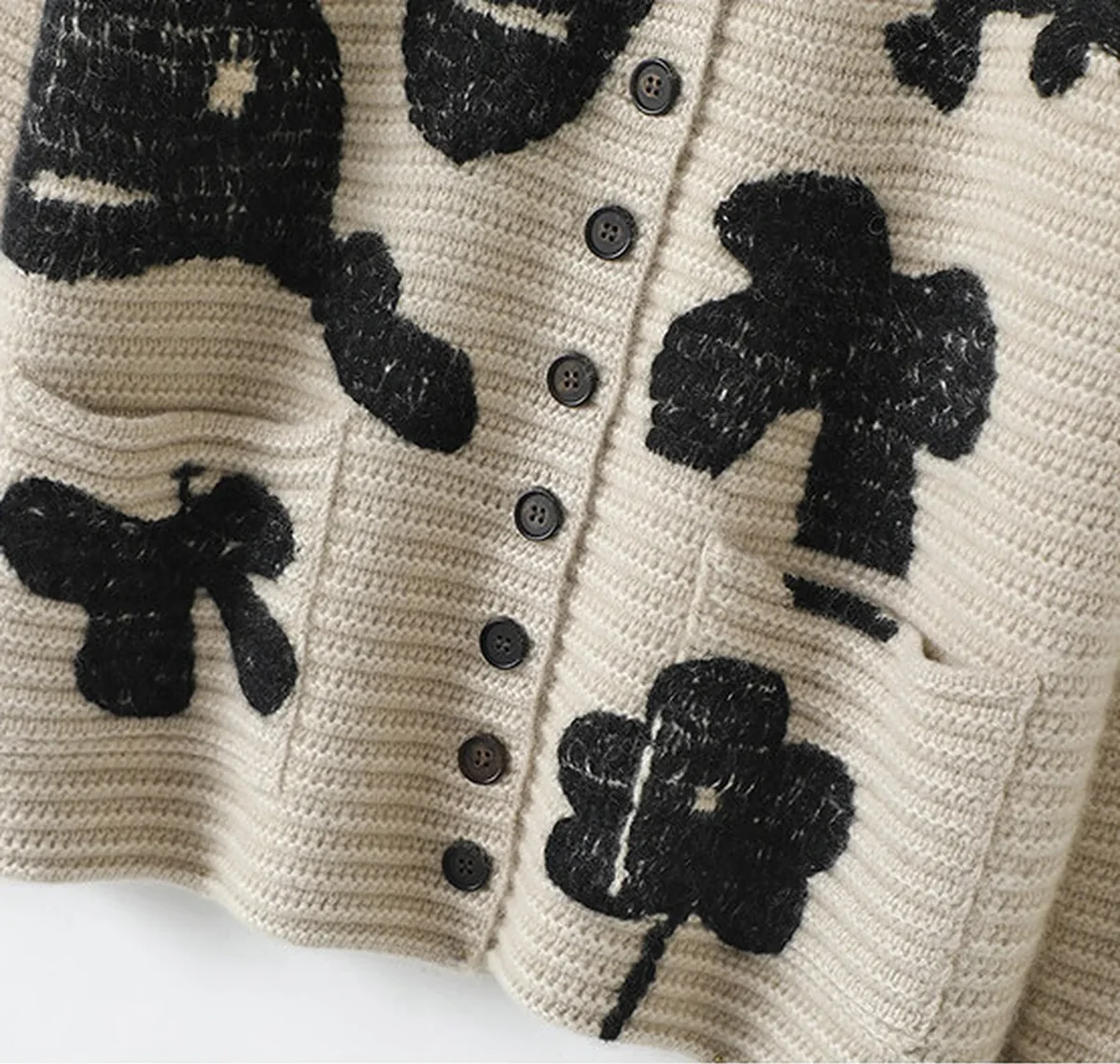
Printed panels can be cut and positioned so the pattern lands where the designer wants. Knitted panels cannot, because the pattern and the panel are the same object. If a jacquard border has to turn the corner at a neckline, or a large intarsia motif has to continue across a shoulder seam, that alignment is decided in the programme before the first panel is knitted.
Practically this means two things are needed from the buyer: the seam positions, and a decision on which side owns the alignment when the two cannot both be perfect. On a wrap cardigan with a continuous patterned band, for example, the band follows the front edge and the belt carries the same motif - the belt is a separate piece, and its alignment is the detail most likely to be wrong on a first sample.
What to confirm before sampling
- Maximum colour count per garment, and whether any colour appears only in a small area.
- Which motifs must hold a sharp outline, and at what gauge you expect to see them.
- Whether any pattern crosses a seam, placket or rib - and which side owns the alignment.
- The weight you will accept. Multi-colour jacquard is warmer and stiffer; if the design needs drape, that is a constraint on colour count.
- The reverse side. Some buyers need a clean back for a transparent look or an unlined cardigan; that changes the technique, not just the finishing.
We programme and knit colour work in Dalang, Dongguan, on our own machines, which means the repeat and the panel are developed together rather than specified separately. Our first step on a multi-colour brief is to redraw the artwork on the stitch grid at the intended gauge and come back with the colour count that the drawing actually needs.
Send a reference image or a flat artwork with your target retail band and colour ceiling. We will tell you whether the motif is better served by intarsia or jacquard, and where the cost will move if the colour count changes.
Intarsia and jacquard: common questions
How can I tell intarsia from jacquard by looking?
Look at the edge of a colour change. Intarsia meets in a stepped, interlocking loop and the reverse shows small yarn pockets rather than floats running across. Jacquard carries the unused colours behind as floats, so the reverse shows horizontal threads crossing the back of the motif.
Which one is more expensive?
It depends on the motif more than the technique. Intarsia carries a set-up cost per colour and more handling, which hurts on small runs; jacquard is efficient for all-over patterns but gets heavy and costly as colour count and float length rise.
Can intarsia be used for a large floral motif?
Yes - it is usually the better route for large motifs with clean outlines, because each area is knitted from its own yarn and the edges stay sharp. The limits are the number of yarns the machine can carry and the handling time per panel.
Why does a multi-colour jacquard feel heavier?
Because the unused colours are knitted in behind the face as floats. More colours mean more yarn carried across the back, which adds weight and reduces stretch - the garment becomes warmer and stiffer at the same time.
Does the pattern need to align at the placket and seams?
Yes, if the design reads as continuous. Alignment is planned in the knit programme, not corrected at make-up, because a knitted repeat cannot be shifted the way a printed panel can.