
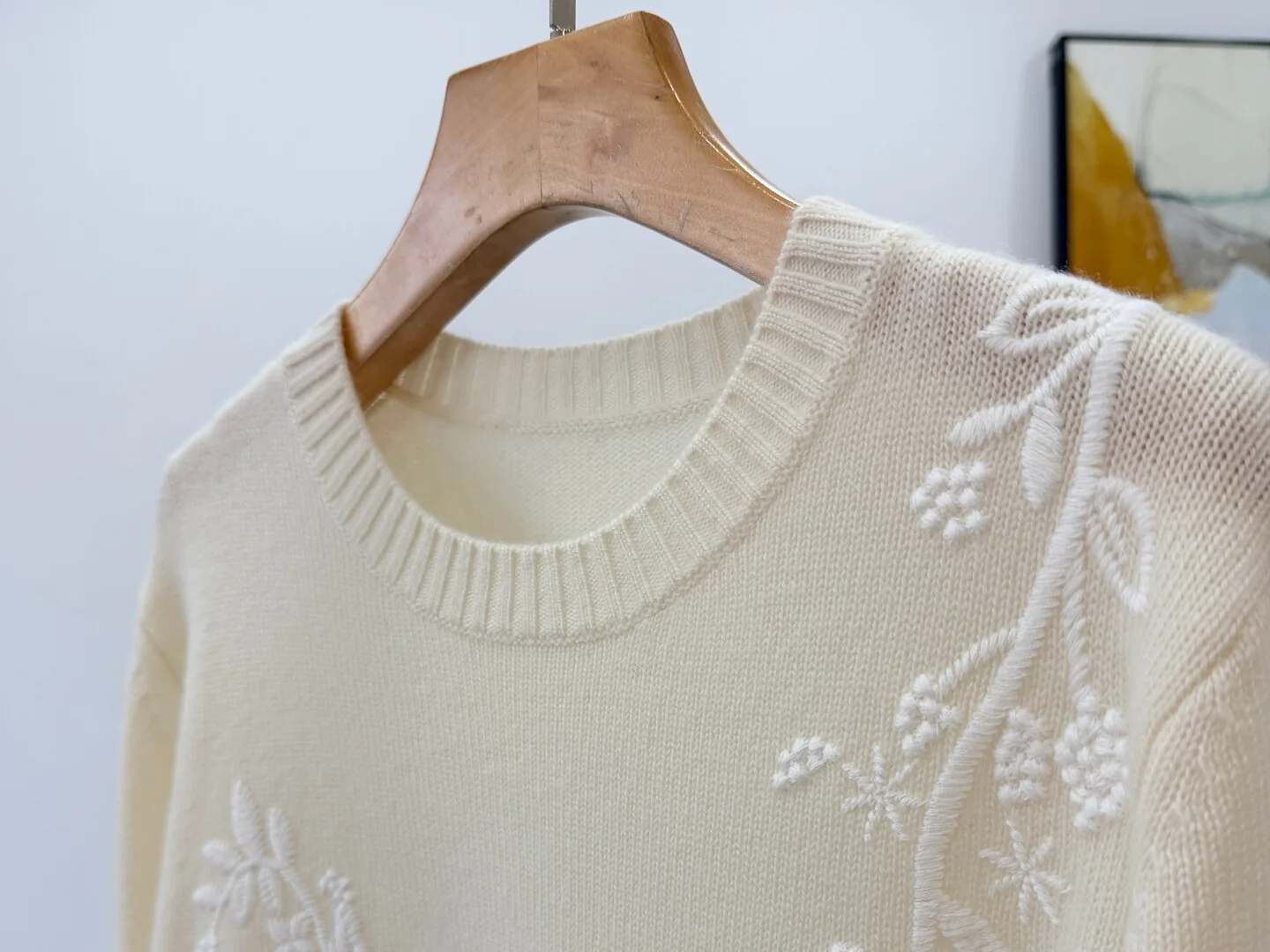
Why the same colour is harder, not easier
With contrast embroidery, the thread does the work. A slight density variation, a half-millimetre of misregistration or a wobbly curve is absorbed by the colour difference. Remove the difference and every one of those becomes the design.
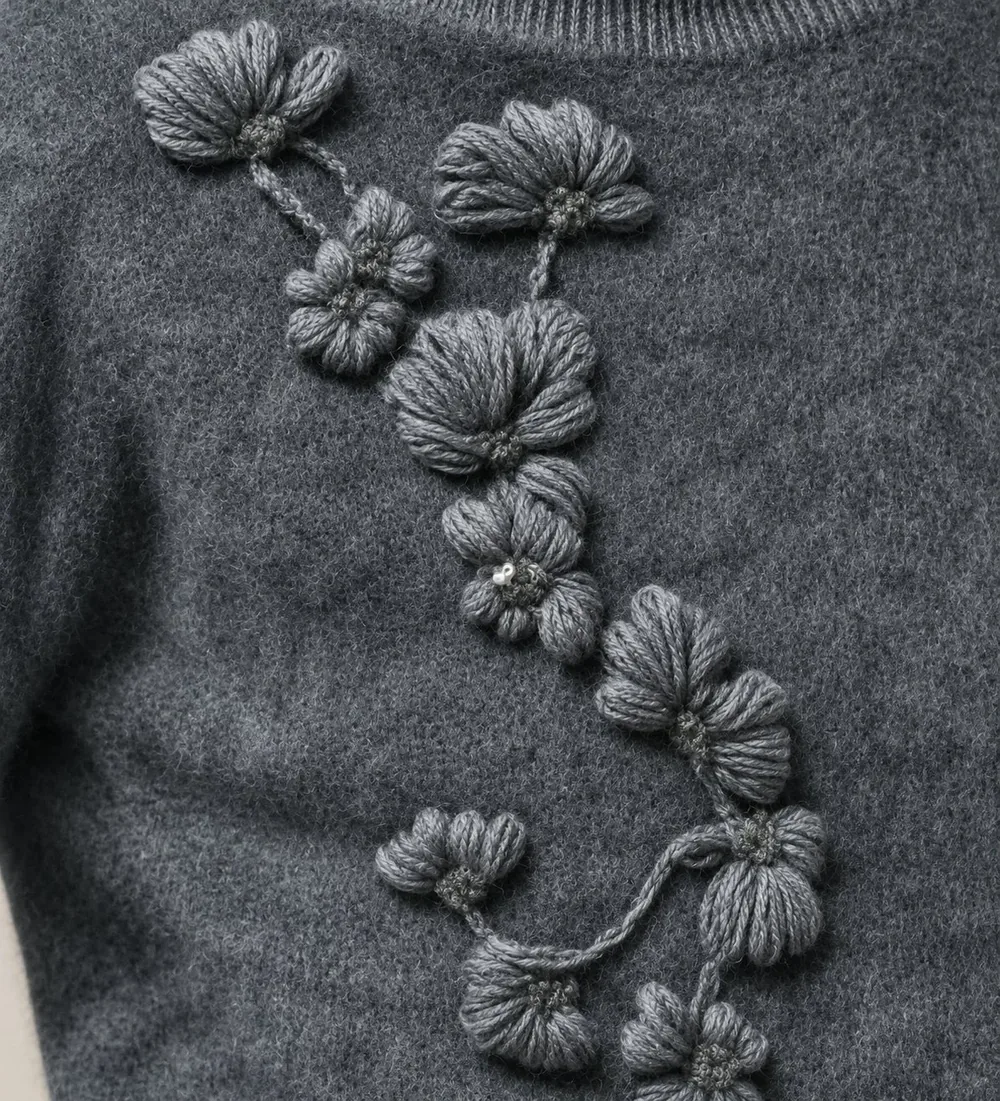
There is a second, less obvious effect: the ground is not a flat colour. A knitted panel has its own surface - loop texture, slight shade variation across the panel, pile if it is brushed. Tonal thread laid across it either respects that surface or fights it. On a brushed yarn the embroidery can disappear entirely if the relief is under about a millimetre, which is why tonal work on hairy yarns usually needs cord or a heavier stitch rather than fine satin.
A style in this construction commonly lands in a retail band of roughly USD 180 to 350, and the difference between a good and a poor version is invisible in a flat photo and obvious in the hand.
Three stitches, three jobs
| Stitch | What it does on knit | Where it belongs | Where it fails |
|---|---|---|---|
| Satin stitch | Flat, dense coverage with a directional sheen; the light line follows the stitch angle | Petals, leaves, solid shapes with a clean perimeter | Large fills on fine soft grounds - the panel gathers under the density |
| French knot | Concentrated height in a very small footprint | Flower centres, buds, dotted texture, small accents | Loosely tensioned knots that flatten or pull through in washing |
| Chain, stem or cord | A raised continuous line that can follow a curve or a stem | Vines, stems, lettering, outlined shapes | Working across a seam - the line breaks at the join |
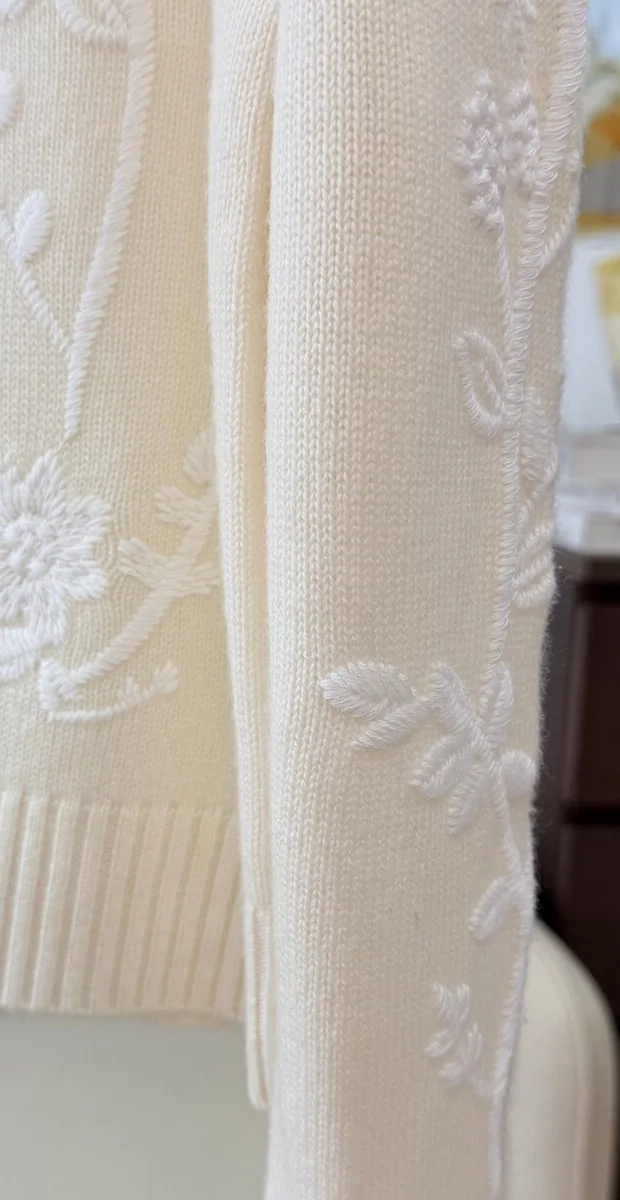
A single flower normally uses all three: satin petals, a knotted centre, a cord stem. The reason a well-made tonal motif looks expensive is that the three are used at different heights, so the eye reads layers rather than a flat appliqué of thread.
The knit-specific risks
Embroidery on woven fabric is a mature, predictable process. On knitwear it is a negotiation with a moving surface. Four things go wrong, and all four are visible on a sample if you look for them:
- Gathering. Dense stitching pulls the loop columns together. The panel narrows along the embroidery and stays narrowed. On a fine gauge this reads as a soft wave; on a rib it reads as a crease.
- Ripple after finishing. The embroidery and the ground take up steam differently. A panel that measured flat before finishing can shift a few millimetres after, which is enough to pull a seam.
- Snagging. Long satin stitches and loose knots catch on jewellery, hangers and neighbouring garments in a carton.
- Shade matching. Tonal does not mean identical - the thread is usually a different fibre from the ground and takes dye differently. On a wool ground with cotton thread the two can drift apart under different light.
What the process adds that buyers do not see
The visible work is the stitching. The cost sits around it:
- Thread-to-ground matching under two light sources. Daylight and shop light show tonal pairs differently; a match approved under one can fail under the other.
- Stabilising and removal. A temporary backing under the placement, then taken out without pulling the stitches.
- Placement proofing on the made-up garment. A motif drawn on a flat panel sits differently once the shoulder seam is closed and the sleeve hangs.
- Stitch count and density trials. The same drawing at two densities gives two different reliefs; the correct one is decided on a swatch, not on paper.
Placement decisions that change the outcome
| Placement | What to expect | What to decide first |
|---|---|---|
| Centre front panel only | Lowest risk; one flat piece to work on | Whether the motif should be symmetric or deliberately off-centre |
| Front and sleeve | Motif must be split at the armhole and still read as continuous | Which side owns the alignment; the sleeve is a separate panel |
| Across a ribbed cuff or hem | Highest risk - rib is dense and elastic | Whether the rib is knitted wider to allow for stitch pull |
| Back neckline | Often the most visible area when the garment is on a hanger | Whether the stitch line follows the neckline curve exactly |
What to confirm before sampling
- The relief you expect, and whether it must remain visible on a brushed or hairy yarn.
- Whether any part of the motif crosses a seam, a placket or a rib.
- Care instruction. Hand wash, dry clean or machine wash changes both stitch density and knot tension.
- Thread fibre. Matching a wool ground with a cotton thread is common and acceptable, but it should be a decision rather than a surprise.
- Whether bead or sequin accents are in scope - they add weight, a wash risk and a packing requirement.
We develop this construction in Dalang, Dongguan, on our own knitted panels rather than on purchased fabric, which is the only way to test gathering and recovery properly: the panel has to be the panel that will be used. Our sequence is ground first, then a stitched swatch at two densities, then placement on a made-up sample.
If you are considering a tonal motif, send the reference with your target retail band and the care instruction you intend to print. Those two lines narrow the technique more than the artwork does.
Tonal embroidery: common questions
What does tonal mean in embroidery?
The thread sits in the same colour family as the ground, so the motif is read through shadow and texture rather than contrast. It succeeds or fails entirely on relief, stitch direction and edge sharpness, because there is no colour difference to hide imprecision.
Which stitch is used for the petals?
Petals are usually satin stitch or long-and-short satin, worked in a consistent direction so the light reflects evenly. Centres are commonly French knots or small knot clusters, because a knot builds height in a compact area.
Will embroidery damage a fine-gauge knit?
It can. Dense stitching on a fine, soft ground gathers the loop columns and leaves a permanent ripple. The usual fixes are lighter stitch density, a stabiliser under the placement, and avoiding large solid fills on very fine grounds.
Why does tonal embroidery cost more than a contrast logo?
Because the tolerance is tighter. A contrast motif absorbs small registration and density differences; a tonal one shows every one of them. More time goes into matching thread to ground, trialling density on the real yarn, and proofing placement on the made-up garment.
Can it cross a ribbed cuff or neckline?
It can, but it is the highest-risk placement. Rib is dense and elastic, so the embroidery sits on a surface that moves more than the body panel. If the motif must cross the rib, knit the rib slightly wider to allow for the stitch pull.