What a knitwear trading company actually does
A trading company sits between you and one or more factories. Its real work is coordination: finding a factory that accepts your quantity, translating your comments into production instructions, following up on the schedule, arranging inspections, consolidating shipments and preparing export documents. For a buyer without local presence and without time, that coordination has genuine value.
The trade-off is distance from production. The trading company typically adds a margin on top of the factory price, and your technical information travels through at least one extra pair of hands. When you ask why a swatch came back with a different gauge, the answer usually goes factory → trader → you, and each step can soften the details.
What changes when you work with a direct factory
With a direct factory, the people who read your reference image are the people who plan the yarn, program the machines and inspect the sample. Technical feedback is faster because there is no relay: a question about whether a cable pattern can hold its shape at your gauge gets answered by the technician who will actually knit it.
There is also a different kind of accountability. When one company develops, produces and inspects, there is no one to blame but itself — which is why factories that control their own quality tend to put the approval checkpoints in writing. The limitation is scope: a single factory has its own machine range, yarn channels and finishing setup, and a very broad product list can be a sign that production is being outsourced.
Five questions that reveal who you are really talking to
| Question | A real factory answers | An intermediary answers |
|---|---|---|
| Who operates the knitting machines on my order? | Names its own workshop and shift pattern | Generally, or "our partner factory" |
| Can I see live production this week? | Yes — a video call during working hours | Needs time to "arrange" it |
| Who made the swatch decisions? | Its own technician, and can explain the gauge choice | Refers to the factory's judgment |
| Whose machines made my sample? | Its own, and can show the programme | Vague, or changes the subject |
| Who is accountable if bulk fails inspection? | Direct, and agrees the remedy in writing | Points to the factory below |
None of these questions is hostile. Professional factories answer them every week; intermediaries who add real value can also answer them honestly, by explaining exactly which parts they handle themselves.
When a trading company is the right choice
A trading company or sourcing agent makes sense when your order mixes categories that no single factory produces well — knitwear plus woven tops plus accessories — and you want one shipment, one invoice and one point of contact. It can also be the pragmatic route if you already have a trusted long-term agent who knows your standards, or if you are testing a market where local knowledge matters more than unit price.
When a direct factory fits better
Knitwear rewards technical depth: yarn behaviour, gauge, construction and finishing interact in ways that are expensive to discover at bulk stage. If knitwear is a core category for your brand, working directly with the team that develops it usually means faster sample iterations, clearer cost breakdowns and a production standard that lives with the people who made it. It also gives your brand a defensible story about where and how the garments are made.
How we fit into this picture
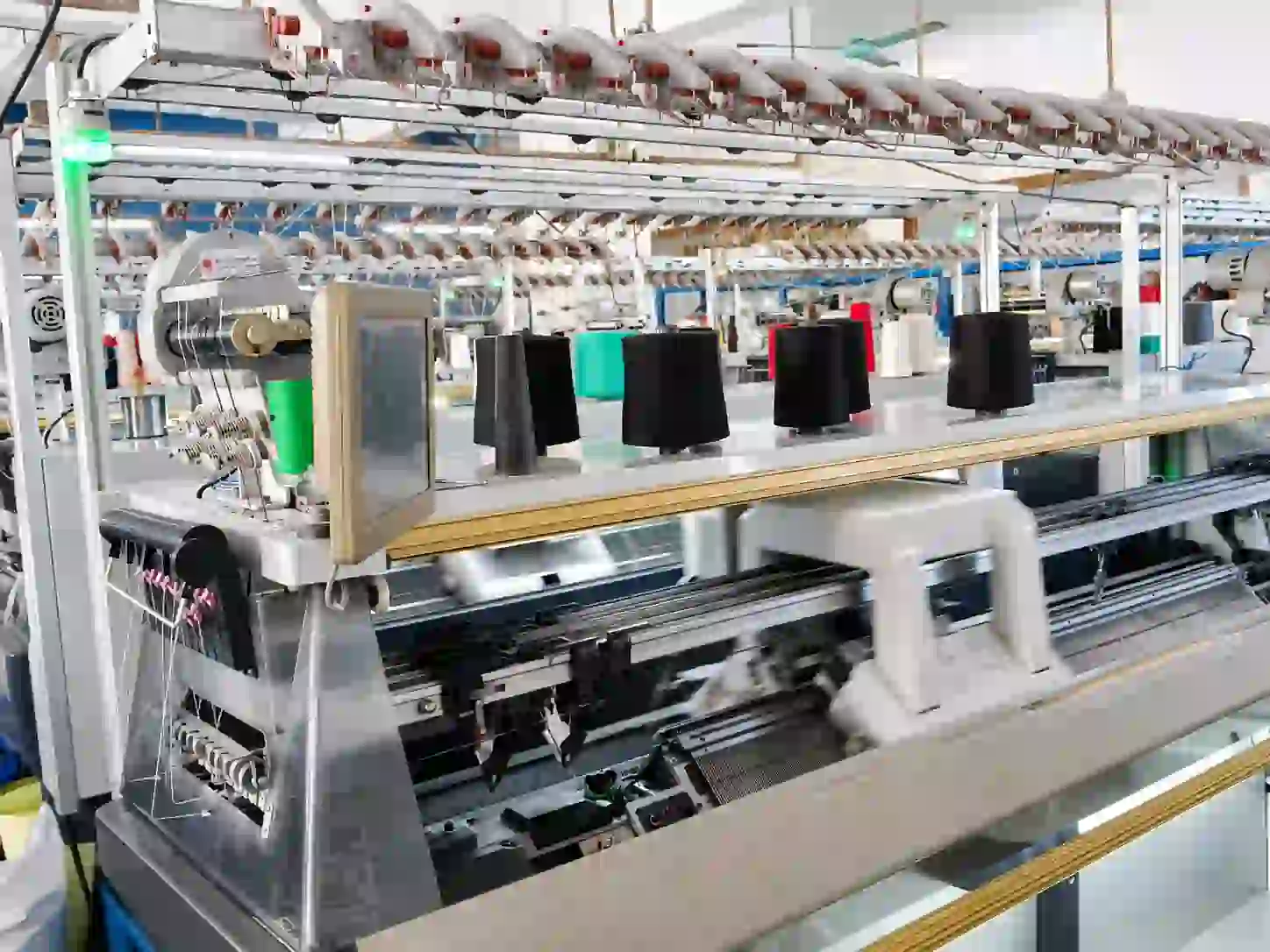
We are a knitwear development studio in Dalang, Dongguan, with our own knitting floor — the machines in the photograph above are ours. Buyers come to us directly for development-led knitwear: swatches, samples and small-to-mid-size production runs. When a project needs categories outside our scope, we say so early rather than pretend the whole order can be made in-house.
If you are weighing both routes for an upcoming programme, send the reference images and quantity range. A written feasibility review — yarn route, gauge, sample plan and an honest statement of what would be outsourced — costs you nothing and makes either route easier to compare.
Knitwear trading company: common questions
Is a knitwear trading company more expensive than a direct factory?
Usually yes at the unit-price level, because the trading company adds a margin on top of the factory price. The comparison is not always that simple, however: a good trading company can prevent expensive mistakes through better coordination and inspection, which on small or mixed orders can outweigh the margin.
Can a trading company do development work?
Some have their own technical team and sample capability. Many do not, and forward swatch and sample work to factories. Ask who physically operates the machines and who makes the swatch decisions — the answers tell you where the real capability sits.
How do I verify a supplier is a real knitwear factory?
Ask for a live video walkthrough of the knitting floor during production hours, check who employs the operators, and confirm whose machines produced your swatch. A factory can show all of this in minutes; an intermediary needs time to arrange it.
Who is responsible when bulk quality goes wrong?
Whoever is contractually accountable to you. Through a trading company, the accountability chain can run through a party that does not control production. Whatever the route, agree the inspection standard and the remedy for failures in writing before bulk starts.
Can I work with both a factory and a trading company?
Yes, and many buyers do: a direct factory for core knitwear development and production, and a trading company or sourcing agent to consolidate other categories into one shipment.
Related: what to ask a knitwear factory before commissioning a paid sample and how to start a custom knitwear project.