
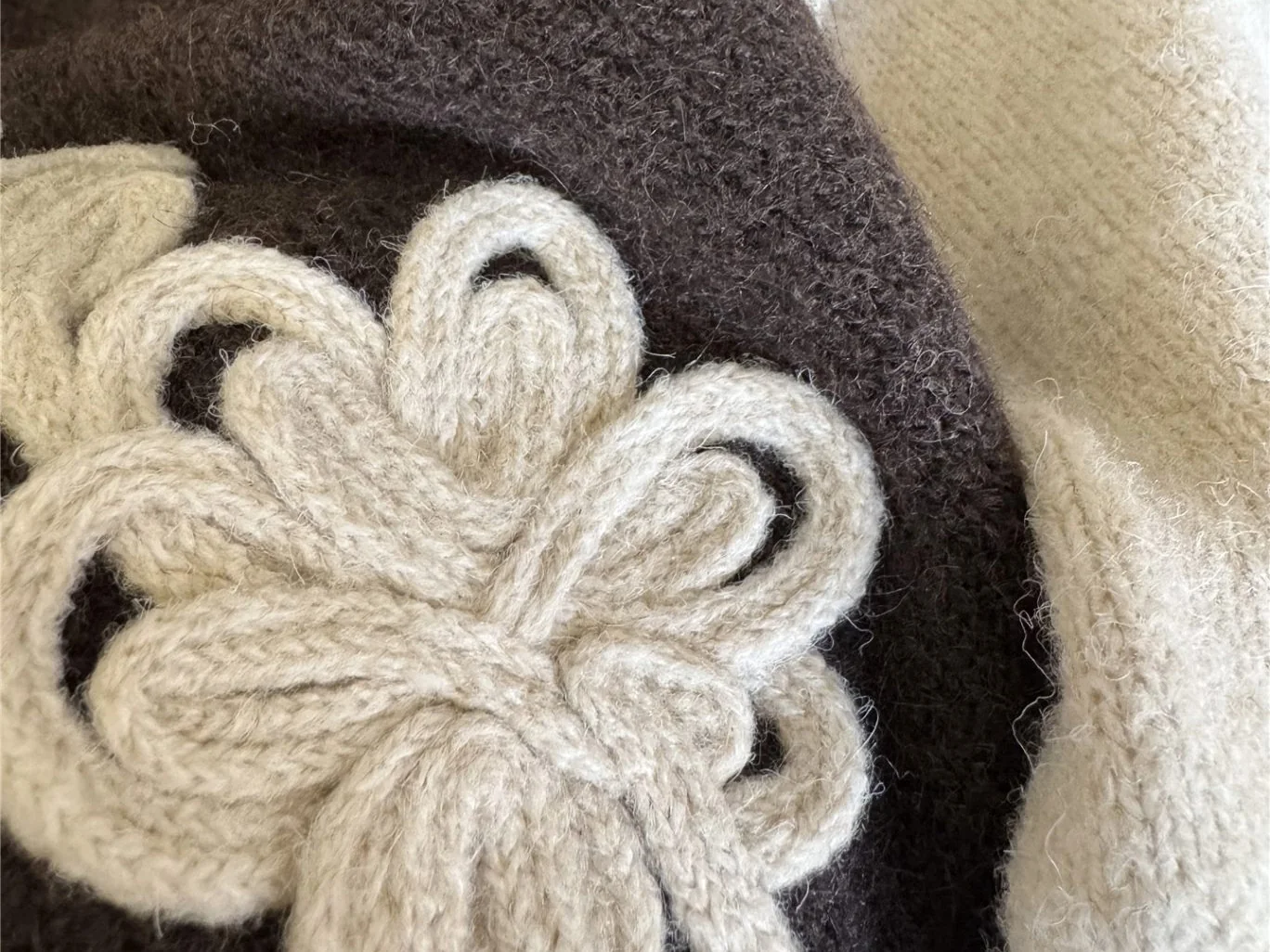
Why knit behaves differently from woven
On a woven fabric the weave locks the yarns, so a dense satin stitch pulls against a stable grid. A knitted panel is a set of interlocking loops. When a needle and a dense stitch line cross it, the loop columns gather, the panel narrows locally, and the distortion stays after the frame is removed. On a fine-gauge merino this can be a visible wave along the motif; on a brushed or hairy yarn it shows as a flattened patch where the pile has been compressed.
That is why the first decision on this type of style is not the artwork. It is the gauge of the ground. A slightly heavier and firmer ground carries a raised motif better than a soft, lofty one, and a brushed surface has to be combed back up after the motif is attached. If the design direction is a soft hand-feel and a heavy raised flower at the same time, those two requests pull against each other and the buyer should know that before approving a yarn.
A style in this construction sits in a designer-brand retail band of roughly USD 700 to 900, and most of that premium is visible hand-work rather than yarn.
Three routes to a raised motif
Almost every raised floral or vine we develop follows one of these three routes. They look similar in a photograph and behave very differently in production.
| Route | How the height is made | Best suited to | Main risk |
|---|---|---|---|
| Coiled cord | A cord, knitted tube or ribbon is laid in loops and stitched down along its length; the cord diameter sets the relief | Vines, stems, outlined flowers, lettering with rounded strokes | Ends working loose; loops flattening if stitch spacing is too wide |
| Stacked appliqué | Cut pieces of felt, fleece or knitted fabric layered and stitched, each layer adding height | Solid petals, leaves, patches, animal or abstract shapes | Layer edges fraying; different shrinkage between patch and base |
| Loop pile | Yarn is looped rather than laid flat, building a tufted surface in rows | Filling a petal or panel with texture; a lighter alternative to a patch | Loop height inconsistency; snagging in wear and packing |
What the production sequence actually looks like
The order matters more than any single step. In our floor the sequence for a cord-based motif runs like this:
- Artwork to placement. The drawing is converted into a placement layout at the actual garment scale, positioned against the panel outline and the seam allowances, not against a flat sketch.
- Panel knitting and relaxation. Panels are knitted and rested before any decoration, because a freshly knitted panel still moves. Attaching a motif to a panel that has not settled produces a motif that shifts after finishing.
- Stabilising. A temporary backing is applied under the placement area so the panel keeps its width while the motif is stitched.
- Motif building. Cord is coiled and pinned or tacked, then stitched along its length. Stacked work is layered and fixed layer by layer, not all at once.
- Edge stitching. The perimeter is closed with a visible stitch - blanket stitch, chain or a tight zigzag - which fixes the edge and becomes part of the design.
- Finishing. Backing removed, panel steamed and measured, surface combed up where pile was compressed, then make-up.
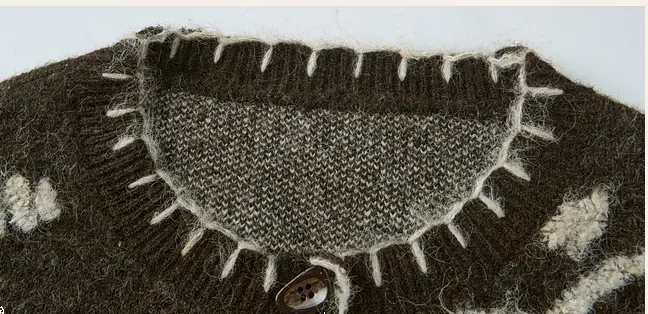
The stitch edging is the decision that decides durability
Buyers usually approve the motif shape and leave the edge to the factory. That is the wrong way round. A raised motif can be fixed in three ways, and only one of them is reliable on knitwear.
| Fixing method | What happens in wear and washing | When we would use it |
|---|---|---|
| Spot tacking only | The motif holds at the tacks and lifts between them; on a looped cord the loops open | Never on a production style - sampling shortcut only |
| Edge stitch, thread matching base | Secure and nearly invisible; the motif reads as a raised surface with a clean shadow line | Tonal work where the relief is the whole point |
| Edge stitch, contrasting thread | Secure, and the stitch line becomes a graphic element; must be consistent or the inconsistency shows | Styles where the outline is part of the design |
There is a second reason to decide the edge early: it changes the artwork. A blanket-stitched outline needs a cleaner shape than a satin-stitched one, because the stitch follows the perimeter and any wobble in the cut line is drawn twice.
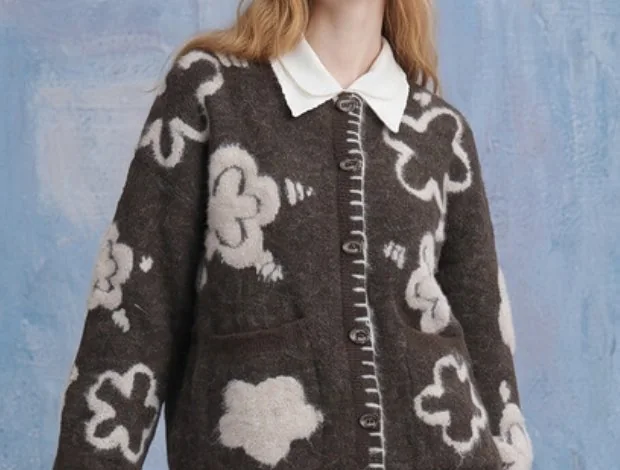
Where the cost actually sits
Material is rarely the driver. A cord motif uses grams of yarn. What moves the price is handling, and it moves in four places:
- Motif count and spread. One vine down a front panel is a different job from the same vine continued onto both sleeves, because the sleeve is a separate panel with its own curvature.
- Pieces per motif. A flower built from one coiled line is quicker than the same flower built from eleven stacked petals.
- Relief height. Taller relief means more anchoring points and more risk of the motif catching during make-up and packing.
- Colourways. Each colourway needs its own thread and cord set-up, and matching a tonal motif to a dyed ground is harder than matching a contrast one, because there is nothing to hide a slight difference behind.
This is also why sampling for a decorated style costs more than sampling a plain sweater, and why the sample fee is normally credited against bulk rather than waived. The first sample is where the placement, the relief and the edge are proven together.
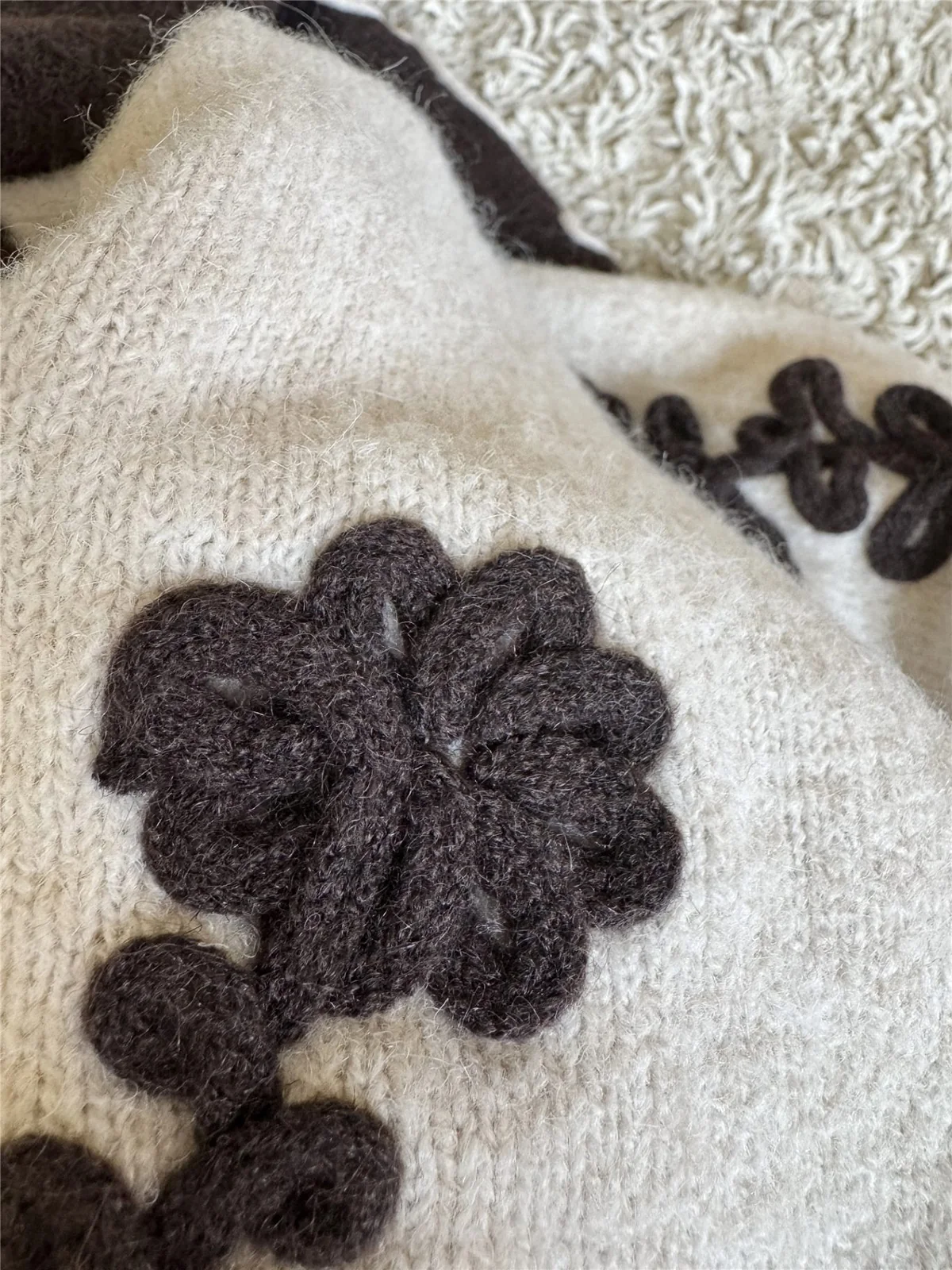
Failure modes worth naming before you approve
| What you see | Cause | Where it is prevented |
|---|---|---|
| Panel waves along the motif | No stabiliser, or too dense a stitch line on a soft ground | Sampling, at the first panel |
| Motif edges fray after washing | Cut edge left raw or only spot-fixed | Edge stitch method agreed before bulk |
| Patch puckers or bubbles | Patch and base shrink differently in finishing or washing | Pre-shrinking the patch material, or matching fibre |
| Motif steps at a seam | Placement planned on the flat, not on the made-up garment | Placement layout before knitting |
| Surface looks flattened and dull | Pile compressed by the frame and not combed back | Finishing step, written into the process |
What to confirm before you commission a sample
- The exact relief height you expect, in millimetres, and whether it must survive pressing.
- Whether the motif crosses a seam, a placket or a rib - and if so, which side owns the alignment.
- Care instruction: hand wash, dry clean, or machine washable. This single line decides the fixing method.
- Whether the motif is tonal or contrast. Tonal work has no margin for a colour mismatch and needs a tighter yarn match.
- How the style will be packed. Tall relief and flat-folding do not combine well without interleaving.
We develop decorated knitwear from Dalang, Dongguan, with our own knitting floor and a hand-work table for cord and stacked appliqué. Our starting position is that the ground, the relief and the edge are one decision, so we quote and sample them together rather than treating the decoration as an add-on after the sweater is approved.
If you have a reference image with a raised motif, send it with your target retail band and care expectation. We will come back with the route we would take, the ground we would knit it on, and an honest note on where the engineering risk sits.
Raised appliqué on knitwear: common questions
What is the difference between appliqué and embroidery on a sweater?
Appliqué fixes a separate material - cord, felt, a knitted patch or fleece - onto the surface and holds it with stitching. Embroidery builds the motif from thread on the surface. On knitwear the difference matters because appliqué adds a second layer with its own shrinkage behaviour, while embroidery adds stitch density onto a surface that stretches.
Why does a knitted base need a stabiliser?
A knitted panel stretches in both directions, so dense stitching pulls the loop columns together and the panel distorts permanently. A stabiliser holds the panel dimensionally while the motif is attached, then is removed or trimmed. Without it the panel waves along the stitch line and no amount of pressing fixes it.
Can a raised motif be washed?
Yes, if the motif is edge-stitched rather than spot-fixed, the cord or yarn ends are secured inside the stitching, and the care label matches what the trim can tolerate. For heavy cord and loop pile we normally recommend hand wash or dry clean, because a machine cycle puts the most stress exactly where the motif is anchored.
Does appliqué add much to the unit cost?
The variable is handling time, not material. Motif count, relief height, how many separate pieces are laid per motif, and whether the work is machine-guided or done by hand all move the cost. Two colourways on one style also means two set-ups.
Can the motif follow a shaped panel and a seam?
Yes, but it has to be planned before the panel is knitted. Running a motif across a shoulder seam or a placket means both sides must match in stitch count; otherwise the motif visibly steps at the seam after make-up.