Buyers often ask for a minimum order quantity at the beginning of a conversation. That is sensible: it helps determine whether a project can move forward. But an answer without a product brief is rarely useful. Two projects with the same total quantity can have very different production conditions when one uses one stock colour and the other uses several colours, a complex stitch structure or a material that needs to be sourced specifically.
1. Yarn is usually the first constraint
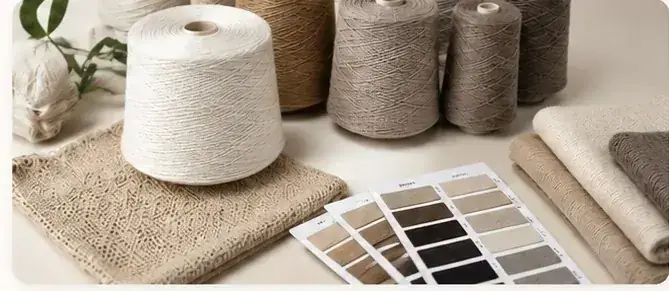
Yarn is not only a design choice. Availability, supplier minimums, dyeing requirements and the amount needed for a particular construction can affect a project before knitting begins. A stock yarn may allow a different route from a custom colour or a specified fibre composition. When material is central to the concept, it should be discussed early rather than added after the quantity has been agreed.
2. Total quantity is different from a usable production mix
A total order may look large enough, but the factory must also see how it is divided. Ten colours with a small quantity in each are not equivalent to one colour at the same total volume. The same is true for size distribution. Buyers should share the expected colour and size mix, even if it is preliminary, so the production discussion starts from a realistic combination.
COLOUR
Each colour is a decision
Colour can affect yarn sourcing, dye lots, programming, labelling and packing preparation.
SIZE
Each size needs a plan
Size breakdown affects measurements, production allocation and the final packing ratio.
CONSTRUCTION
Gauge and stitch matter
Gauge, structure, pattern and finishing affect set-up, yarn use and production complexity.
DELIVERY
Timing changes options
Sample approval, material confirmation and packing requirements all need time before bulk production.
3. A small order can still have a valid role
Small quantity does not automatically mean a project is impossible. It may be a sampling exercise, a market test or the first stage of a repeat programme. The practical question is what the order is intended to achieve, and whether its material, colour and construction choices support that route. A clear brief helps a factory suggest an appropriate next step without promising an arbitrary MOQ.
4. What to send before asking for MOQ
Send a reference image or sketch, expected total quantity, colour and size breakdown, material direction, target market and desired sample or delivery window. If any requirement is flexible, say so. This allows the development team to identify which elements are fixed and which can be adjusted to make the project more practical.
FAQ
Common MOQ questions
Can a factory give a MOQ before seeing the style?
It can provide a broad indication, but a useful project answer requires the style, material, colours and expected quantities.
Does a lower MOQ always mean a higher price?
Not automatically. However, small quantities can change how material sourcing, set-up and production costs are distributed. Compare quotations only when the product assumptions are aligned.
Can I start without a Tech Pack?
Yes. A clear reference image and a brief covering material, quantity, target market and timing can be enough for an initial feasibility review.